

There is a fundamental human desire to leave a mark on the world, to create something that outlasts us, to know that our existence has mattered. In Islamic tradition, this longing finds its ultimate expression through Islamic waqf, a transformative practice that allows ordinary people to create legacies lasting centuries. We see this desire across every culture and throughout history: parents invest in their children’s future, artists create works they hope will endure, architects design buildings meant to stand for centuries, leaders establish institutions they hope will outlast them. Yet Islamic waqf offers something uniquely powerful.
In Islamic tradition, this desire for lasting legacy finds its highest expression in Islamic waqf, a charitable endowment that creates perpetual benefit. Waqf represents one of Islam’s greatest contributions to civilization, enabling individuals to create institutions that serve humanity indefinitely. When a Muslim establishes an Islamic waqf, they are saying: “I will not merely consume what Allah has blessed me with. I will create something that continues to serve and benefit long after I’m gone. My rewards for this action will continue indefinitely, as will the blessing to those I serve.”
This is the profound blessing of Islamic waqf, it allows ordinary people to create extraordinary legacies while earning spiritual rewards that transcend time and mortality.
The Nature of Legacies and Islamic Waqf
What makes a legacy meaningful? Unlike other forms of inheritance, waqf stands out for its permanence. Consider the different types of legacies people create:
Financial Legacies
Many people seek to leave wealth to their heirs. While this can be valuable, wealth rarely survives more than a few generations. Studies show that 70% of wealthy families lose their wealth by the second generation, and 90% lose it by the third. Money, when inherited without the discipline and values that created it, tends to dissipate.
Family Legacies
Others hope to establish family names, businesses, or reputations that endure. Certainly, some family enterprises have indeed thrived for centuries. However, family legacies are fragile, they depend on each generation’s commitment to maintaining the legacy and adapting to changing circumstances.
Professional Legacies
Some people aspire to be remembered for their professional achievements: scientific discoveries, artistic creations, intellectual contributions. These can indeed outlast individuals. Yet professional legacies often reach only specialized audiences and may fade as new discoveries or approaches replace earlier work.
Spiritual Legacies
Others invest in their children’s spiritual development or establish religious institutions. These create profound and enduring impact. Indeed, a person’s influence on another person’s spirituality can echo through generations.
Community Legacies
People establish institutions, facilities, or programs meant to serve communities. Schools, hospitals, libraries, and community centers created by visionaries can serve millions of people across centuries.
Why Islamic Waqf Stands Apart
Among all these legacies, Islamic waqf is uniquely powerful because it combines community benefit with structural sustainability. Unlike other legacy types, a waqf doesn’t depend on any individual’s continued involvement or belief. Once properly established, it continues to serve regardless of what happens to heirs or successors.
The Qur’anic Perspective on Legacy
The Qur’an frequently addresses the human desire for lasting impact and the folly of accumulating wealth without spiritual benefit:
“Wealth and children are adornments of this worldly life, but the everlasting good deeds are far better with your Lord in terms of reward and in terms of hope.” (Quran 18:46)
This verse presents a striking contrast: wealth and children are described as temporary “adornments,” beautiful perhaps but ultimately fleeting. In contrast, “everlasting good deeds” carry lasting reward. Islamic waqf perfectly embodies everlasting good deeds, actions that continue to benefit people long after the founder has passed away. For more information on the Qur’anic foundations of charity, see Islamic teachings on charity.
Furthermore, the Qur’an also teaches: “It is not righteousness that you turn your faces toward the East or the West, but righteousness is to believe in Allah and the Last Day and the angels and the Book and the prophets and to give wealth, in spite of love for it, to relatives, orphans, the needy, the traveler, those who ask [for help], and for freeing slaves; [and to be among] those who establish prayer and give zakah; and [those who are] faithful to their promises when they make them; and those patient in poverty and hardship and during battle. Those are the ones who have been true, and it is those who are the righteous.” (Quran 2:177)
This verse beautifully captures the Islamic ethic: true righteousness encompasses not merely internal belief or ritual practice alone, but also concrete action to benefit others, even when it requires sacrifice. Waqf exemplifies this principle, giving from what we love while creating lasting benefit for others.
The Prophet’s Teaching on Waqf and Continuing Reward
One of the most frequently cited hadith in Islamic discourse on waqf is the teaching of the Prophet Muhammad (peace be upon him):
“When a person dies, their deeds end except for three: a continuing charity (sadaqah jariyah), knowledge that benefits others, or a righteous child who prays for them.”
This hadith carries profound wisdom. It acknowledges a fundamental truth: most of our actions cease when we die. Our business endeavors, our professional accomplishments, our personal projects, all end with our mortality. However, three things continue: continuing charity, beneficial knowledge, and righteous children.
Waqf as Sadaqah Jariyah: The Perfect Charity
Waqf represents sadaqah jariyah in its purest form, charity that continues indefinitely. While a merchant who dies no longer conducts business, and a scholar who dies no longer teaches, and a parent eventually passes on, a waqf continues to benefit people indefinitely. Importantly, the founder’s reward also continues indefinitely as their charitable action generates ongoing benefit.
Consider the profound implications: someone who establishes a waqf that serves people for 500 years earns the reward of 500 years of continuous charity. Although the founder passed on centuries ago, their reward continues because their charitable action continues to generate ongoing benefit. This embodies the Islamic concept of living legacy.
Waqf and Mortality: Transcending Our Temporal Limitation
How Islamic Waqf Transcends Mortality
Human mortality is an undeniable reality. We have limited time on earth, limited energy, limited resources. We cannot personally serve everyone who needs help, nor can we personally be present to help future generations. This fundamental limitation can be depressing, what’s the point of any action if we won’t be here to see its long-term impact?
Waqf offers a practical solution to this existential limitation. Through waqf, our finite resources and efforts can create infinite benefit. For example, a farmer who establishes an agricultural waqf cannot personally farm forever, yet the waqf continues. Similarly, a physician who establishes a medical clinic waqf cannot personally work forever, yet the clinic continues. Likewise, a teacher who establishes an educational waqf cannot personally teach forever, yet the institution continues.
In this way, Islamic waqf transcends mortality. It allows mortals to create immortal legacies. Through waqf, we participate in the eternal, we create something that, if properly managed, continues to benefit people for centuries or indefinitely.
This is not merely theoretical. The institutions and waqfs established 500 or 1000 years ago actively serve people today. Although their founders have been dead for centuries, their legacies live on. This opportunity is available to us as well. The waqf we establish today could serve people 500 years from now.
The Blessing of Intentionality
The Power of Intentional Waqf Giving
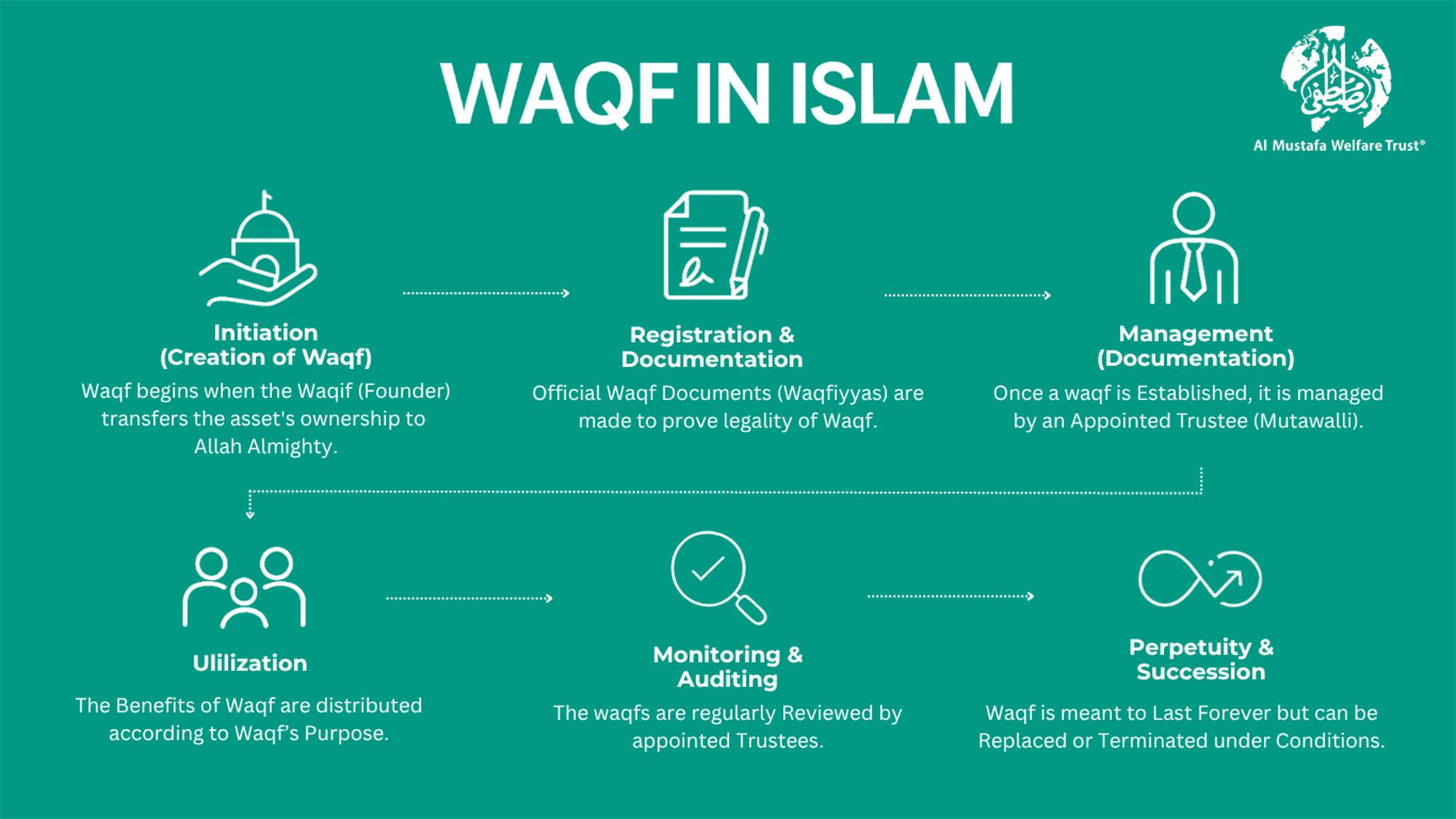
One of the distinctive features of Islamic waqf is that it requires intentionality. You cannot accidentally establish a waqf. Instead, it demands deliberate choice: deciding what to contribute, determining how it will serve the community, establishing governance, and formally dedicating it.
This intentionality is itself a blessing. It prompts deep reflection on questions such as: What do I truly care about? What breaks my heart about my community? What would I want to contribute to? How can I create lasting positive change?
Many people accumulate wealth without pausing to consider its deeper purpose. They earn, they spend, they consume. Waqf, by contrast, requires thinking differently. It says: “Some of what I have should not be consumed by me, but dedicated to benefit others indefinitely.” Significantly, this mental shift, from personal consumption to communal contribution, is itself transformative. Establishing a waqf is one of the most beneficial things a person can do because the benefit continues indefinitely.
Waqf as Expression of Trust in Allah
Building Trust Through Islamic Waqf
Establishing a waqf requires a particular kind of faith. When someone establishes a monetary waqf, for instance, they invest money conservatively, accepting modest returns (often 3-5% annually) rather than pursuing higher profits. This requires trust that these modest returns will indeed prove sustainable and sufficient for the waqf’s purpose.
Likewise, when someone establishes a property waqf, they accept that they can no longer personally benefit from the property (through selling it for maximum profit or using it for personal gain). Instead, they trust that the property will be maintained and that the rental income will support the waqf’s mission. This also requires faith that the governance structure will prove honest and effective.
Furthermore, when someone establishes a service-based waqf, dedicating their time and expertise, they trust that others will value their contribution and continue the work after they’re unable to participate. This requires faith in both community and divine providence.
The Qur’an teaches: “And whoever fears Allah, He will make for him a way out. And will provide for him from where he does not expect.” (Quran 65:2-3) Trust in Allah’s provision forms the foundation of waqf. When establishing a waqf, one trusts that Allah will sustain it and continue to bless it.
Importantly, this trust is not naive. Throughout history, properly established and managed waqfs have been sustained, often thriving for centuries. This trust finds grounding in Islamic history and in the demonstrated reality that when we dedicate resources to serving Allah’s creation, Allah indeed provides.
Humility: The Gateway to Waqf and Spiritual Growth
Establishing a waqf requires humility. It demands acknowledging that resources are not truly ours, but are entrusted to us by Allah. The Qur’an states: “To Allah belongs whatever is in the heavens and whatever is in the earth.” (Quran 2:284)
When we establish a waqf, we acknowledge this principle by saying: “These resources are ultimately Allah’s. I have been blessed to access and steward them. Rather than keeping them for myself alone, I dedicate them to His service and for benefit to His creation.”
Significantly, this is not merely philosophical. A spiritual transformation occurs when someone shifts from the mentality of ownership to the mentality of stewardship. Rather than thinking “This is mine, I deserve it, I’ll use it as I wish,” they begin to think “This is a trust from Allah. How can I use it in the best way? How can I create maximum benefit for others and for the Ummah through waqf?”
This shift in consciousness brings multiple blessings. First, it aligns the person’s heart with Islamic values. Second, it creates psychological freedom, the anxiety of protecting and accumulating possessions diminishes when you recognize that nothing is truly yours. Finally, it generates spiritual growth, as the person learns to place trust in Allah rather than in personal accumulation.
The Impact of Waqf on Beneficiaries
Beyond the personal blessing to the founder, tremendous blessing extends to those who benefit from waqfs. Consider what waqfs make possible:
Access to services that would otherwise be unavailable: A medical waqf provides healthcare to people who couldn’t otherwise afford it. An educational waqf offers learning opportunities to people without resources. A social service waqf delivers aid to vulnerable populations.
Dignity and independence: Rather than depending on charity (sadaqah), which can feel demeaning, beneficiaries of waqf receive benefits from an institution. Notably, there’s a crucial distinction, sadaqah is a voluntary gift, while waqf is institutionalized, guaranteed support. This structure can feel more dignified.
Reliability and consistency: Sadaqah remains unpredictable; some days someone gives, other days they don’t. By contrast, a waqf provides consistent, reliable support. A school waqf ensures that a building is maintained, teachers receive payment, and students are educated year after year. This reliability enables beneficiaries to plan and build on the support.
Opportunity for advancement: Waqf-funded education, training, and economic opportunity empower people to escape poverty and develop their potential. Someone educated through an educational waqf might subsequently establish their own waqf, creating exponential impact. Learn more about waqf on Wikipedia and its historical role in Islamic civilization.
While the founder receives the blessing of doing good, beneficiaries receive the blessing of sustained support and access to opportunities that transform their lives.
How Islamic Waqf Strengthens Communities
Beyond individual recipients, entire communities are blessed by waqfs. Consider a neighborhood with multiple waqfs, one for education, one for health services, one for social support, one for community facilities. Together, these waqfs create a foundation of community strength and resilience.
Such communities become less dependent on external systems. If government support fails or economic circumstances change dramatically, the community maintains internal institutions that continue to serve core needs. Consequently, this creates both resilience and dignity, the community cares for itself rather than depending on outside aid.
Furthermore, successful waqfs inspire others. When people witness a waqf functioning well and creating visible positive impact, they feel inspired to establish their own waqfs. Communities with a culture of waqf develop networks and ecosystems of institutions serving multiple needs. Ultimately, this proves far more powerful than any individual waqf in isolation.
The Blessing of Spiritual Development
The Spiritual Dimensions of Waqf Practice
Establishing and managing a waqf is not merely a practical matter, it’s deeply spiritual. It engages people in multiple dimensions:
Service to others: “The best of you are those most beneficial to others.” Waqf provides a structured way of being beneficial.
Consultation and collaborative decision-making (Shura): Establishing and managing a waqf typically involves consulting with community members, mosque leaders, and beneficiaries. Islamic teaching emphasizes this practice of shura throughout.
Accountability and integrity: Waqf management demands transparency and honest stewardship. These practices develop moral character.
Long-term thinking: Rather than focusing on immediate personal benefit, waqf requires thinking about generations to come. This perspective shift prioritizes long-term good.
Trust in Allah: Waqf requires faith that Allah will sustain the institution and provide for its needs.
Together, these spiritual practices develop and refine the character of those involved in waqf work.
Waqf Legacy Across Generations
One of the most profound aspects of waqf is its intergenerational impact. A waqf established by a grandparent might be serving the grandchildren and great-grandchildren decades later. The children grow up in a community where their ancestor is remembered not just as a family member, but as a community benefactor. The ancestor’s name may be preserved, “This school was established by the waqf of [founder’s name].” This practice keeps the founder’s memory alive and creates a tangible link across generations.
Moreover, children who grow up in communities with strong waqf cultures learn the value of community service and long-term thinking. They often feel inspired to establish their own waqfs. A single waqf can catalyze a tradition of waqf across generations, where each generation establishes new waqfs and improves existing ones. This is precisely how great charitable civilizations are built.
Waqf and the Islamic Ideal of Civilization
Islamic civilization, at its heights, was characterized by networks of waqfs supporting education, medicine, social services, and infrastructure. The great libraries, hospitals, schools, and public fountains that defined Islamic golden ages were often funded through waqfs. These institutions served not just the wealthy but the entire population, including the poorest.
When Islamic civilization weakened, it wasn’t primarily due to military defeat or economic collapse alone, but often because the waqf systems that supported community strength deteriorated. The revival of Islamic civilization, many scholars argue, must include the revival of robust waqf systems.
Modern Muslims have the opportunity to participate in this revival. By establishing strong waqfs, we participate in the Islamic civilization-building project. We create the institutions that will serve our communities for generations. We revive the traditions that made Islamic civilization great.
Overcoming Barriers to Waqf
Overcoming Common Obstacles to Establishing Waqf
If Islamic waqf is such a blessing, why don’t more people establish waqfs? Several barriers exist, yet each can be addressed:
Understanding and Overcoming Waqf Barriers
Barrier 1: Limited Knowledge
Many Muslims aren’t fully aware of what waqf is and how to establish one. Education about waqf is the critical first step in removing this barrier. Numerous resources, workshops, and mentoring programs can help.
Barrier 2: Fear and Uncertainty
Some people fear establishing a waqf because they’re uncertain about legal requirements or management complexity. Working with experienced advisors can effectively alleviate these concerns. Many organizations offer guidance on legal structures and governance models.
Barrier 3: Limited Resources
Some believe they lack sufficient resources to establish a waqf. However, waqfs can be established with modest resources at any scale. Additionally, multiple people can contribute collectively to create larger impact. Even small, focused waqfs create meaningful impact in their communities.
Barrier 4: Skepticism About Governance
Some worry that waqf resources will be mismanaged or misused. Though this concern is legitimate, transparent governance, regular audits, and community accountability address it effectively. Clear accountability mechanisms protect waqf assets.
Barrier 5: Attachment to Possessions
Perhaps most fundamentally, establishing a waqf requires letting go of personal control and personal benefit from resources. While this is spiritually challenging for some, it’s precisely this letting go that brings spiritual growth and freedom. Many who have taken this step report deep fulfillment.
Beginning Your Islamic Waqf Journey
If you’re inspired to establish a waqf, begin by asking yourself some questions:
Reflection Questions for Waqf Founders
Whatneeds in my community touch my heart?
What resources do I have that could address these needs?
What impact would I like to create that would continue for generations through a waqf</strong>?
How can I create a structure that will continue to serve even after I’m no longer involved?
Who else in my community might be interested in establishing a collective waqf?
From these reflections, a vision begins to emerge. A waqf that matches your resources, passion, and community’s needs. Then take the practical steps: consult with experienced people, work with religious and legal advisors, establish governance structures, and make your waqf vision a reality.
Legacy Beyond Mortality
The human desire to leave a meaningful legacy is not mere ego or vanity, it’s a reflection of our deep recognition that we’re part of something larger than ourselves. We want our existence to matter. We want to know that our life made a difference.
Islamic waqf is the Islamic answer to this deep human longing. It allows ordinary people to create extraordinary legacies, mortals to create institutions that transcend mortality, individuals to participate in the eternal through their continued reward as their charitable acts continue to benefit people indefinitely.
The Prophet taught that when we establish sadaqah jariyah (continuing charity) through waqf, our rewards continue even after we’ve died and moved on to the afterlife. This is the ultimate blessing of Islamic waqf, not merely in this world, but reward extending into eternity.
The waqf we establish today could be serving people 500 years from now. The person we help through our waqf might go on to establish their own waqf, creating exponential ripples of blessing. The children who grow up in a community strengthened by our waqf will inherit a legacy of generosity and community service.
This is the profound blessing of Islamic waqf: it allows us to transcend our mortality, to create lasting positive change, to participate in building an Islamic civilization rooted in justice and compassion, and to earn reward that continues indefinitely.
Your community needs your waqf. Future generations need your vision and generosity today. Don’t wait for perfect circumstances or unlimited resources. Start now, wherever you are, with what you have. Establish your waqf. Create your legacy. And in doing so, become part of a centuries-old tradition of serving humanity and earning reward that knows no end.
May Allah bless all those who have established waqfs in the past, all those establishing waqfs today, and may He grant us the wisdom, resources, and commitment to establish waqfs that serve our communities for generations to come. Ameen.
Want to read more about mosque? Click here>>>
Or want to give infaq? There’s Infak.je.
For more info about carpets? Check out Nusantara Carpet.
Want to deepen your knowledge of religious lectures? Check out Ceramah Ringkas